
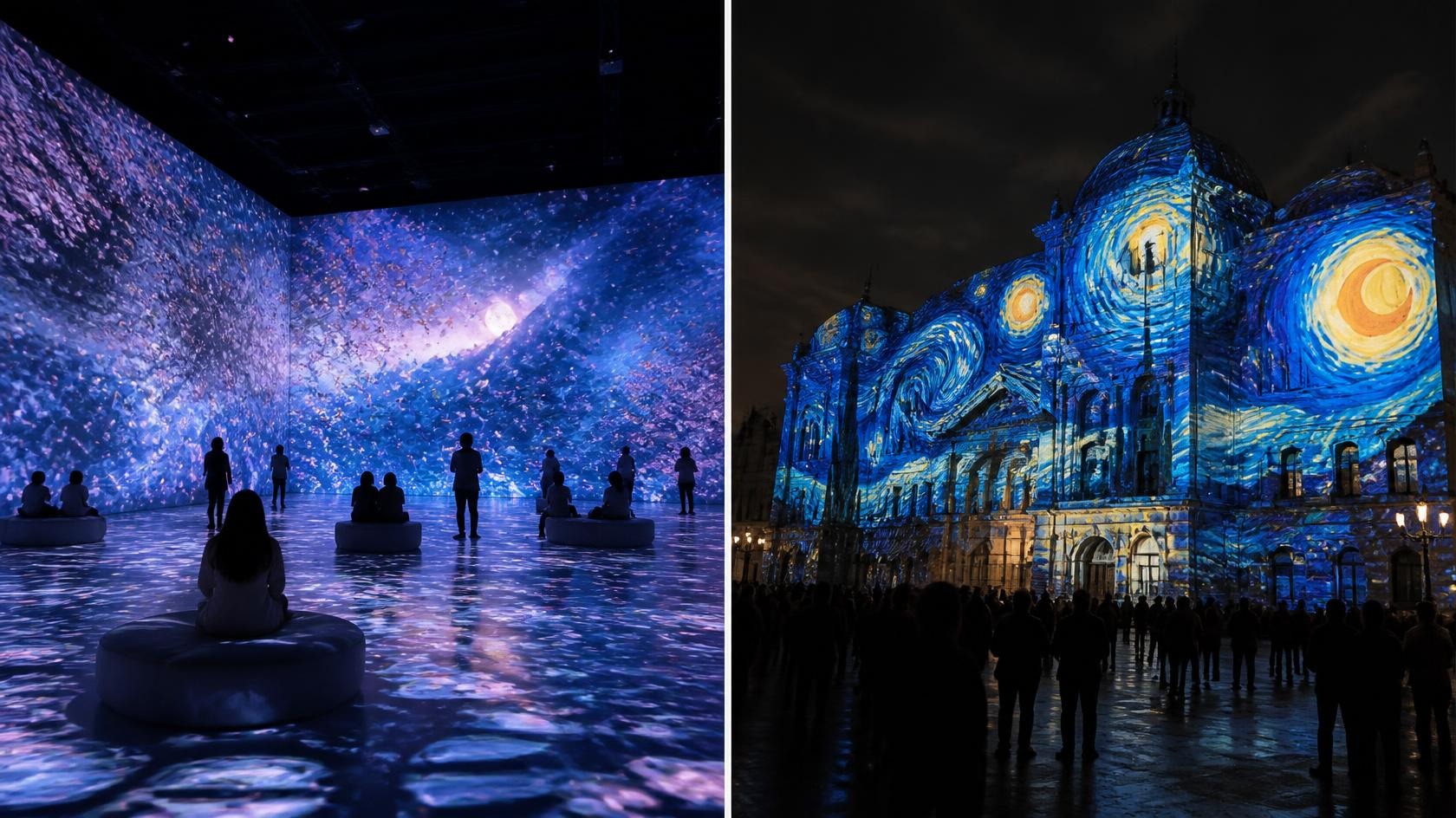
Projection mapping and immersive projection are related but not interchangeable. Both use projectors and visual content, and both can be combined with interaction or multi-projector systems. The difference is how the visual design relates to the space and what the audience is meant to experience.
A project may need one approach, the other, or a combination. The decision should be based on the physical environment, the content, the audience, and the way visitors will move through or observe the installation.
What Is Immersive Projection?
Immersive projection creates a visual environment across one or more surfaces. The audience may be surrounded by walls, floors, ceilings, or a combination of surfaces. The focus is on spatial continuity and the feeling of being inside the visual content rather than viewing a single display.
- Large visual environments that extend across a room or defined area.
- Wall, floor, ceiling, and multi-surface projection.
- Content composed for different viewing positions and movement paths.
- Continuous visuals that connect several surfaces or screens.
- Optional interaction, audio, lighting, and control integration.
Immersive projection is often considered when the visual experience should become part of the environment. Visitors may walk through the content, stand within a defined scene, or experience a sequence that changes across the space. The visual composition and projection layout must therefore be planned around audience movement and viewing angles.
What Is Projection Mapping?
Projection mapping adapts visual content to the geometry of a physical object, surface, or structure. The projected image is aligned to the shape of the target, which may be a building, stage set, sculpture, product, installation, or architectural feature.
- Architectural surfaces and building facades.
- Objects and sculptural forms.
- Stages and performance environments.
- Temporary installations and exhibition structures.
- Irregular or non-planar surfaces that require geometric alignment.
The value of projection mapping comes from the relationship between content and physical form. A mapped surface can appear to change material, move, open, or transform while remaining physically fixed. This makes the technique useful when the object or architecture itself is part of the visual story.
Key Differences
| Factor | Immersive Projection | Projection Mapping |
|---|---|---|
| Main purpose | Create a surrounding visual environment | Adapt visuals to a physical structure or object |
| Typical surfaces | Walls, floors, ceilings, multiple surrounding surfaces | Buildings, objects, stages, installations, and structures |
| Spatial approach | Continuous visual environment | Geometry-specific visual adaptation |
| Content approach | Designed around the visual space and visitor experience | Designed around the physical form and alignment |
| Audience relationship | Audience can move within the environment | Audience often views a defined object, surface, or stage |
| Interaction | Can be integrated when required | Can be integrated when required |
| Multi-projector systems | Often applicable | Often applicable |
The table does not imply that one approach is better. Each method solves a different visual problem. Some projects use immersive surfaces as the primary environment and add mapping for a specific architectural element or stage piece.
When Immersive Projection May Be Appropriate
Immersive projection may be appropriate when the experience should surround visitors, when several surfaces need to work together, or when the visual content needs to follow a visitor route. It can suit exhibitions, digital art spaces, themed environments, experience venues, and installations where atmosphere and spatial continuity are central to the concept.
- The audience should feel inside the visual environment.
- Multiple walls, floors, or ceilings need to form one visual composition.
- Visitors move through the space along a planned route.
- The content is designed around atmosphere, scale, and spatial sequence.
- The project needs a flexible visual environment rather than a single focal surface.
When Projection Mapping May Be Appropriate
Projection mapping may be appropriate when the physical structure is central to the concept. The shape, edges, windows, columns, or mechanical movement of an object can be used as part of the composition. This can be valuable for stages, buildings, product presentations, cultural structures, and installations with a clearly defined form.
- A specific structure or object must become part of the visual content.
- The visual design depends on precise alignment with a surface or form.
- The audience views the mapped object from a defined distance or direction.
- The content should create the impression that a physical surface is changing.
- The project uses architecture or a stage set as the visual focal point.
Can They Be Combined?
Yes. Immersive projection and projection mapping can be combined when a project requires both a surrounding visual environment and geometry-specific projection. The system may use multiple projectors, edge blending, mapping, interactive sensors, and centralized control to coordinate the different visual layers.
A combined approach can be useful in exhibition spaces, live events, themed attractions, and mixed-use venues. The important point is to define which surfaces create the environment and which surfaces require object-specific alignment. This prevents the content design from becoming unnecessarily complex.
Questions to Ask Before Choosing
- What surfaces need projection?
- Is the architecture or object part of the visual experience?
- Does the audience move through the space or view it from a fixed area?
- Is interaction required?
- What content needs to be displayed?
- What are the installation conditions?
- Will the system need to change between different content or operating modes?
- How will the system be calibrated, controlled, and maintained?
How the Choice Affects Content Design
Immersive projection and projection mapping place different demands on content design. Immersive content often needs to work across several surfaces, viewing positions, and movement paths. The composition may be designed as a continuous environment rather than a single frame.
Projection mapping content must account for the exact geometry of the physical object or surface. Edges, openings, folds, and architectural details may become part of the composition. The content team needs accurate references and a clear understanding of the target geometry before production begins.
- Immersive content: continuity, spatial composition, multiple viewpoints, atmosphere.
- Projection mapping content: geometric alignment, masking, object outlines, surface mapping.
- Combined projects: separate content layers for the environment and mapped elements.
- Playback: single sequence, multiple channels, cues, or synchronized sources.
- Update process: how the venue will change content after installation.
How the Choice Affects Installation and Calibration
The choice between immersive projection and projection mapping also affects installation and calibration. Immersive projects may require careful projector placement around the audience, blending across large surfaces, and consistent image quality from multiple viewing positions. Projection mapping adds an additional requirement: the projected image must align with the geometry of a specific object or structure.
- Projector positions and the available mounting structure.
- Projection distance, lens selection, and image overlap.
- Surface preparation, masking, and geometric correction.
- Calibration time and access to the projection area.
- Testing from the main audience positions.
- Documentation of alignment settings for future maintenance.
Calibration is easier to manage when the physical target is stable and accessible. If the object or surface can move, change, or be reconfigured, the project team should decide how that change affects the alignment and whether the system needs to support multiple mapping presets.
How the Choice Affects Operation
Once the system is in operation, the venue team needs clear procedures for content playback, system startup, shutdown, troubleshooting, and routine checks. The operating model may be different when a single mapped object is used instead of an immersive environment with several surfaces and interactive elements.
- Who starts and stops the system each day?
- How are content changes loaded and verified?
- What checks confirm that mapping and blending remain aligned?
- How is interaction reset or calibrated where applicable?
- Who handles basic troubleshooting and who provides remote support?
- What backup content or operating mode is available if a component is unavailable?
A Practical Selection Framework
- Start with the experience: should visitors be surrounded, focused on an object, or both?
- Define the projection surfaces and whether their geometry is part of the content.
- Review audience movement, viewing positions, and interaction requirements.
- Plan content before finalizing the projection layout.
- Confirm installation conditions, calibration access, and maintenance.
- Choose immersive projection, projection mapping, or a combined approach based on those requirements.
This framework keeps the decision grounded in the project rather than the technique itself. In some projects, the answer will be clear. In others, the best result will come from combining approaches and assigning each surface a specific role.
Evaluate the Approach as a System
The final decision should be reviewed as part of the complete projection system rather than as a comparison between two labels. Projector positions, lenses, playback, signal routing, control, surface preparation, and maintenance access all change depending on how the content is intended to relate to the space.
- Can the projectors be placed where the visual concept requires them?
- Do the selected surfaces support the intended image quality and viewing angles?
- Will the content be produced for one surface, several surfaces, or a specific object?
- Are mapping, blending, or geometric correction required, and who will maintain them?
- Does the operating team need to switch between different visual configurations?
- Are updates likely to change the projection layout, content, or interaction behavior?
A system-level review also makes it easier to identify where a combined approach adds value. For example, an immersive environment may create the surrounding atmosphere while projection mapping highlights a central object or architectural feature. In that case, each technique has a clear role rather than being added only for visual effect.
Related Technologies
Both approaches depend on reliable projection, content preparation, signal distribution, control, and installation. Reviewing the technical system as a whole helps determine whether the project needs a surrounding environment, object-specific mapping, or a combination of both.
Related Technology / Products
Related Insights
Projection Technology
How to Choose Projectors for an Immersive Projection Project
Read Article →Project Planning